How to find UGC creators on TikTok with Claude
Give your agent a creator brief and it will search TikTok by style, judge craft from transcripts, and hand you a shortlist of makers.

How do I find UGC creators on TikTok?
A UGC creator is someone paid to film product videos a brand posts or runs as ads, so craft matters more than followers. Your agent builds the shortlist from live TikTok data. You contact the maker, agree rights and pay. It runs on Manifold MCP.
How to find UGC creators on TikTok in eight steps
- Connect Manifold MCP to Claude (claude.ai, Claude Desktop or Claude Code), or to ChatGPT.
- Write the creator brief: the product, two or three proof-of-fit products, the styles you want, whether you need a face on camera or hands and voice-over, a follower range, and where the video will run.
- Search TikTok by style rather than by niche.
- Group the rows by author, drop brand accounts, resellers and repost pages, and read the bios.
- Check craft from transcripts and length, then open the best videos by eye.
- Read the comments on each finalist's best product video for buying questions.
- Vet the audience only if the creator's handle will run the video, then build the shortlist.
- Keep new makers coming with a Keyword tracking monitor on your style terms.
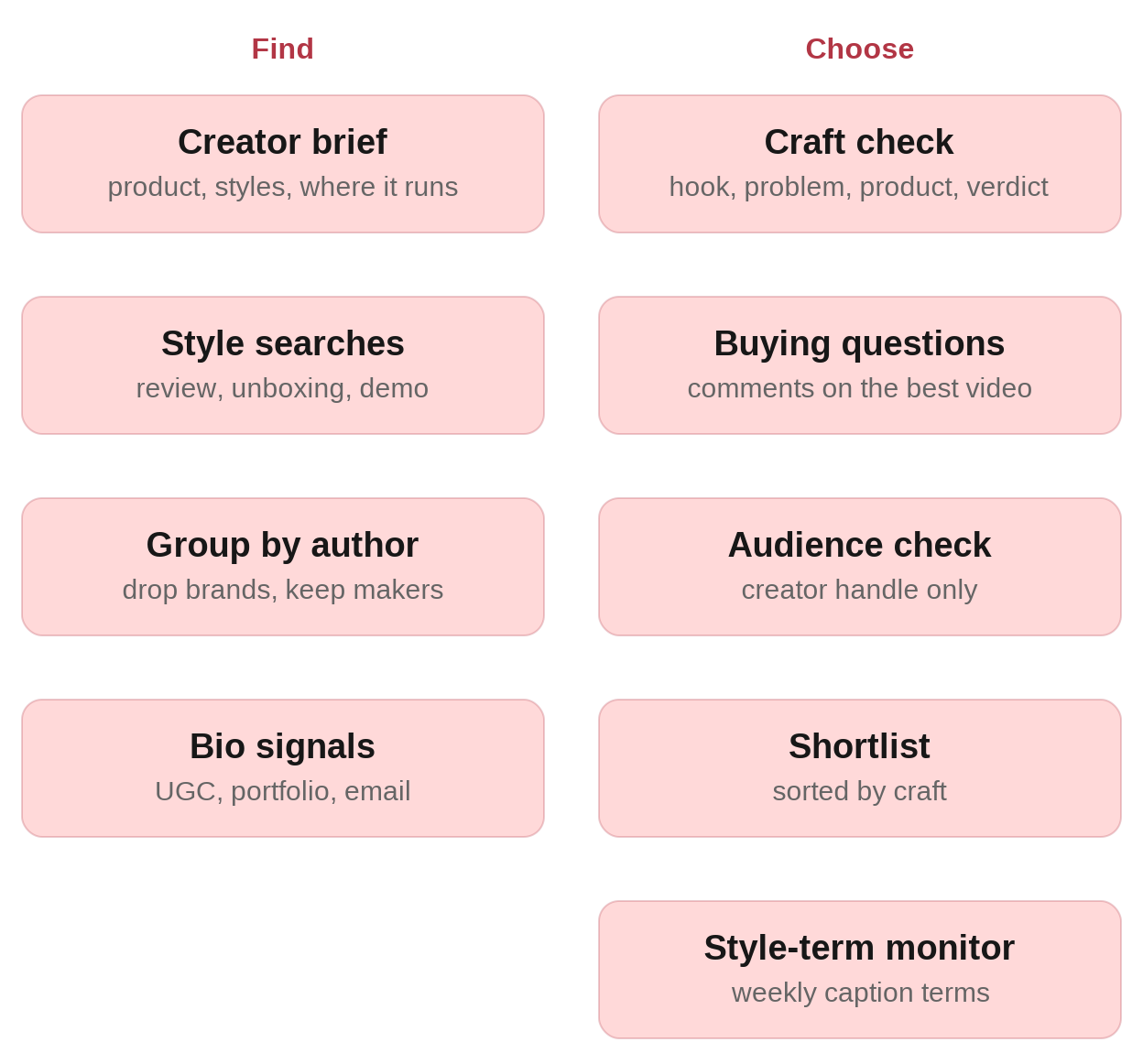
This page covers hiring makers on TikTok for product videos: style searches, maker signals in bios, a craft check from transcripts and length, buying questions in comments, an audience check only when the creator's handle runs the video, a craft-sorted shortlist, and a style-term monitor. For creators whose audience you are paying for on Instagram, see how to find Instagram influencers with Claude. To film the videos yourself, see how to find TikTok video ideas. If you only want what did best this month, that job is research TikTok and Instagram. Named rival accounts and outliers belong to TikTok competitor analysis. Hashtags and keywords as mentions belong to how to track TikTok hashtags. A roundup of TikTok servers is the best TikTok MCP servers.
What AI engines suggest, and the shorter path
Ask how a brand can hire makers on TikTok for product review and demo videos it could run as ads, using Claude or ChatGPT (checked November 2026), and the engines describe a loop: write a brief, search by format and product words, group by creator, judge craft from real videos, audit comments, take public contact, rank with evidence, draft outreach, and agree paid usage in writing. A small maker with tight demos beats a large account that rambles.
The tools they suggest are a stack you assemble: creator marketplaces, influencer databases, local TikTok servers, hiring platforms, and AI ad generators. Several need an account of their own.
Manifold MCP searches TikTok and reads profiles, transcripts, comments, followers and audience countries inside the chat: hosted, with no TikTok login, developer app or local server of yours, and you pay per call.
Step 1: connect Manifold MCP
Every account gets 250 credits a month on the free plan. The credits page lists what calls cost.
Claude. Follow the Claude setup page: Customize, Connectors, add a custom connector, then sign in.
Claude Code. On the Claude Code setup page, run the install command, then /mcp and sign in in the browser.
ChatGPT. ChatGPT lists Manifold as an official app. On the ChatGPT setup page, find it in Apps or follow the plugin link, click Connect, and sign in. You do not paste a server URL, and developer mode is not involved. On Business, Enterprise and Edu, whether the app is available is an admin setting.
Ask this to confirm the connection:
Name the Manifold tools that search TikTok videos, read a profile, list an account's videos, return a spoken transcript, return comments on one video, list followers, return audience countries by share, and create a monitor.
The reply should list tiktok_search_videos, tiktok_get_profile, tiktok_get_videos, tiktok_get_transcript, tiktok_get_comments, tiktok_get_followers, tiktok_get_audience and monitoring_create_monitor.
Step 2: write the creator brief
Give your agent the product, two or three competitor or adjacent products whose reviews count as proof of fit, the styles you want (review, unboxing, demo, problem and solution, "TikTok made me buy it"), whether you need a face on camera or hands and voice-over, a follower range, and where the video will run: your handle, the creator's handle, ads, or a product page. Small creators are fine. You pay for the video, not the reach.
Where it runs decides whether the audience matters. If you post the video or run it as an ad from your own account, the maker's followers barely count. If it runs from the creator's handle, the people who already watch them are the buy.
Step 3: search by style
Your agent calls tiktok_search_videos with style plus category, not a broad niche: "[category] review", "[competitor] honest review", "tiktok made me buy it [category]", "[product type] unboxing". Style queries tend to surface TikTok UGC creators; broad niche queries tend to surface influencers.
Use since year in a small category, month in a busy one. Take a couple of pages each; the next page is a cursor. Search is TikTok's own ranking and is not complete. Each row already carries author_followers, so a first size cut needs no extra call. Keep author, author name, URL, followers, caption, views, likes, comments, duration_s, is_ad, hashtags and the video URL. Those rows leave transcript and comments empty, so later steps call those tools.
Parameters live on the TikTok tools page.
Optionally, your agent calls ads_search_ads on tiktok and facebook for the category. The rows name the advertiser, plus headline, body, format, first shown, last shown and a media URL. They do not name the person on camera, so your agent opens the ad or its media to see who is in it. The ads tools page has the parameters. Ad library servers compared: the best ad library MCP servers.
Step 4: group by author and read the bios
Your agent groups the rows by author. It drops brand accounts, resellers and pages that repost other people's videos. It keeps authors with two or more product-style videos, or one strong one (a clear demo with a verdict).
Then it calls tiktok_get_profile on each kept author for bio, the link in bio (website), followers, following, posts count and likes. Profile views is empty. There is no email field, so contact is whatever the bio and the link in bio show. A bio that says "UGC creator", lists a portfolio or rate card, or prints a business email marks a working maker.
is_ad flags ads, boosted posts and paid partnerships, and it is unreliable in both directions. Your agent also reads captions for ad or partner tags. Paid brand work in the feed is a plus here: it shows they already deliver to brands.
Step 5: check craft
Your agent calls tiktok_get_transcript on one product video each for the top ten. A maker who opens with a hook, names the problem, shows the product working and ends with a verdict can make an ad. One who talks for a long time before the product appears cannot. The transcript is the full spoken text, uncut, with no timestamps. NoData is a video with no speech TikTok stored, such as music or text on screen: keep it and mark it. Set ai_fallback when you still need the words. Extra credits, and only for videos of two minutes or less.
Then it reads duration_s against the ad lengths you run. Photo carousels have no duration. Views on a maker's own posts are a weak signal for this job, because the clip will reach people through your account or your ads.
You open the best videos to judge on camera, light and sound by eye, because the rows have no picture of the frame.
Step 6: read the comments
Your agent calls tiktok_get_comments on each finalist's best product video, a page each. Buying questions ("where is this from", "does it work for") are the best sign the creator can sell. Generic praise or the same line from a handful of accounts is a warning. Keep commenter handles out of anything you publish.
There is no search across many videos. If you want comments on a set of posts coded, use how to analyze TikTok and Instagram comments.
Step 7: vet the audience when their handle runs the video, then build the shortlist
Skip this check when you will post the video or run it as an ad yourself. When it will run from the creator's handle, your agent calls tiktok_get_videos (one page, then ordered by created_at, because pinned old videos can sit first) for median views and view rate (median views over followers). It reads one page of tiktok_get_followers together with that view rate: many real viewers have empty profiles, so a hollow page on its own is weak evidence. On finalists only, it calls tiktok_get_audience for the country split. Read share and ignore count. The split is a sample of recent followers, and it describes followers, not viewers. That call costs more than the other TikTok lookups, which is why it waits until the last names.
Then the shortlist, sorted by craft. This table is an illustration. Handles, numbers and hooks are placeholders, not a real shortlist:
| Creator and link | Followers | Styles | Best example | Hook | On camera | Brand work | Contact | Fit |
|---|---|---|---|---|---|---|---|---|
| [@creator] | [n] | review, unboxing | [url], [views] | "[first spoken line]" | face | rate card in bio | bio email, link in bio | [one line on fit] |
Your agent drafts outreach in the chat. You send it, agree usage rights, rates and duration, and pay.
Step 8: keep new makers coming
Ask your agent to run monitoring_create_monitor with preview on, so you see the terms and TikTok as the only platform, and to create it once you agree. Creating it and its scheduled checks spend no credits. A check you ask for outside the schedule (Run now) spends credits.
Dashboard. Open social media monitoring, choose Keyword tracking, restrict it to TikTok, add your style terms, and set weekly.
Pick terms makers write in captions or hashtags, for example "[category] review", "ugc", "[product type] unboxing". On TikTok, a check calls tiktok_search_videos for each term, since week, sort latest. A video is reported when the caption or the hashtags hold the term (case does not matter; a hashtag still matches if you wrote the words with spaces). Each new video is reported with who posted it, the first part of the caption, and likes, comments and views. Spoken words are not matched. Checks default to hourly; weekly is plenty for new makers. The opening run saves a baseline and lists no new videos. Later checks report videos that appeared after that. See how monitors work for weekly vs hourly. The monitoring tools page has the create call.
Once a week, ask which new videos come from makers worth adding. Your agent uses monitoring_get_changes for that list. Claude and ChatGPT do not fire this on a timer. You ask.
The free plan keeps 1 monitor, and that one can watch up to 3 terms. Plans set how many monitors you keep: 1 on Free, 5 on Pro, 25 on Growth, 100 on Agency.
Run this in your agent
Connect Manifold to Claude, ChatGPT or Cursor, then paste this prompt.
Build a shortlist of TikTok makers who film product videos for [Acme] in [category], videos we could post or run as ads. Creator brief: product [product]; proof-of-fit products [competitor], [adjacent]; styles review, unboxing, demo, problem and solution, TikTok made me buy it; on camera [face / hands and voice-over]; follower range [min] to [max], small creators are fine; the video will run from [our handle / the creator's handle / ads / product page]. Call tiktok_search_videos for these queries: [category] review, [competitor] honest review, tiktok made me buy it [category], [product type] unboxing. since year if the category is small, since month if it is busy. sort relevance. A couple of pages each, one page at a time via cursor. Search is ranked by TikTok and is not complete. Keep author, author_name, author_url, author_followers, created_at, text, likes, comments, views, duration_s, is_ad, hashtags, url. Search rows leave transcript and comments empty. Optionally call ads_search_ads platform tiktok and platform facebook, query [category]. Rows name the advertiser, not the person on camera; open the ad or its media to see who is in it. Group rows by author. Drop brand accounts, resellers and repost pages. Keep an author who has two product-style videos, or one strong demo that ends on a verdict. Call tiktok_get_profile on each kept author. Read bio, website (the link in bio), followers, following, posts_count, likes. views is empty. Contact is only what the bio text and website field show; do not expect an email column. Maker signals: a bio that says UGC creator, a portfolio, a rate card, a business email. is_ad flags ads, boosted posts and paid partnerships and is unreliable in both directions; also read captions for ad or partner tags. Paid brand work is a plus. Call tiktok_get_transcript on one product video each for the top ten. Score each transcript on four things: an opening hook, the problem named, the product shown working, a verdict; mark makers who take long to reach the product. Transcripts have no timestamps. NoData means no speech TikTok kept: keep the video and mark it. Use ai_fallback only on a video up to two minutes that the table cannot do without; it costs extra. Compare duration_s with the ad lengths we run. I will open the best videos to judge on camera, light and sound by eye. Skip ranking by own-post views; they do not show how the clip will perform as your ad. Call tiktok_get_comments on each finalist's best product video, a page each. Treat buying questions (where is this from, does it work for) as the strongest sell signal. Generic or repeated comments from the same few accounts are a warning. Leave commenter handles out of anything you write for publishing. If the video will run from the creator's handle, call tiktok_get_videos one page, then order by created_at (pinned old videos can sit first), and take median views and view rate (median views over followers). Call tiktok_get_followers one page and read it with the view rate; a hollow page on its own is weak. Call tiktok_get_audience on finalists only. Read share, ignore count. Treat the split as a follower-country sample, not a viewer sample. If we post the video or run it as an ad ourselves, skip the audience check. Give me a table sorted by craft, not followers: creator and link, followers, styles, best example (URL, views), hook from the transcript, on camera (face, voice-over, hands; I will confirm by opening the video), brand-work signs, contact (bio or link in bio), one line on fit. Do not invent numbers or findings. Draft outreach in the chat; I will send it, agree usage rights, rates and duration, and pay. Then preview a Keyword tracking monitor, TikTok only, weekly, for these style terms: [category] review, ugc, [product type] unboxing. Description: New makers posting [category] reviews and unboxings so we can add them to the shortlist. Show the preview first, then create the monitor after I confirm. Each week I will ask which new videos come from makers worth adding; read them with monitoring_get_changes.
Limits to know
What the tool descriptions and docs say:
- A search is a ranked sample, not a full listing.
- The tools read words and numbers, not how a video looks (on camera, light, editing, text on screen).
- Speech comes back as one uncut block, with no timestamps. A video with no kept speech returns
NoData. - An email is not a profile field. Take contact from the bio and the link in bio.
is_admisses some paid posts and flags some that are not.- Country share is from a sample of recent followers, not from viewers.
- Comments arrive for one video at a time.
- Rates, usage rights and availability are not in the rows.
- Some fields come back empty when the source does not publish them.
Paste the prompt with your product, styles and where the video will run.
The other TikTok articles cover ideas, hashtags and rival accounts.