How to monitor competitors' social media with Claude
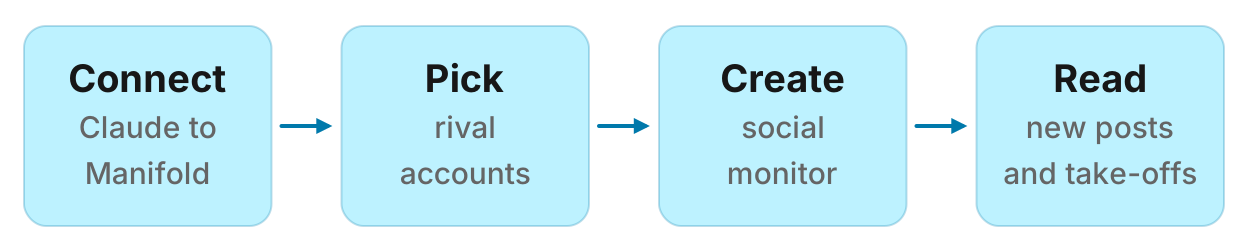
Connect Claude to Manifold MCP, create a social account monitor for rival accounts, and have Claude read new posts and the ones that take off.


How do I monitor competitor social media?
Competitor social media monitoring is a scheduled watch of named rival accounts: new posts, and the ones that take off against that account's usual. People searching the job still land on listicles of per-seat listening suites and analytics dashboards. Those tools live in their own app. They do not set up the watch inside Claude, or have the agent read the feed and turn it into "what should we do".
This is the setup. It uses social media monitoring on Manifold MCP: a Social account tracking monitor that checks 1 to 10 public accounts on a schedule, then Claude reads the feed. You connect Claude, list the rival accounts, create one daily monitor, and ask what they posted and what took off.
How to monitor competitor social media in four steps
- Connect Manifold MCP to Claude (claude.ai, Claude Desktop or Claude Code) with OAuth 2.1, or an API key.
- Pick 2 to 4 direct rivals, and the 2 platforms each actually uses. LinkedIn company page URL, Instagram, TikTok and YouTube handles, Facebook page URL.
- Create a Social account tracking monitor. Ask for daily (or weekly). Preview the monthly credit cost first. Creating it costs 0 credits.
- Let the first check record a starting point, then ask Claude what they posted and what took off after the second check.
Creating a monitor costs 0 credits. Each check pays for the tool calls it makes, at the same credit prices as a one-off call. Each account is about 1 credit per check. Default cadence is hourly, so on the free plan ask for daily or weekly. Alerts start on. Monitors are on every plan, including Free with 250 credits a month. Monitors a workspace can keep, by plan: 1 on Free, 5 on Pro, 25 on Growth, 100 on Agency. For types, cadences and the estimate the form shows, see how monitors work.
Monitoring vs listening vs analytics
Three jobs share the words "competitor" and "social". Mixing them up is how you buy the wrong tool.
Account tracking (this guide). Named accounts, on a schedule. New posts, with likes, comments and views. A flag when a post takes off against that account's usual in the same read. Claude groups the feed and writes the "what to test" summary. The product page is social media monitoring.
Keyword mentions. Posts that name a brand, a product or a hashtag across LinkedIn, Instagram, TikTok, YouTube and Reddit, not only on the rival's own accounts. That is the mentions preset on the same product page, and the roundup of listening platforms with their own MCP servers is the best social listening MCP servers. Instagram searches each keyword as one hashtag, so pick a tag people actually use. Facebook and X keyword search are not covered.
Analytics dashboards. Follower growth over time, engagement rate benchmarks, share of voice, sentiment scores, client-ready reports. Brand24, Sprout Social, Hootsuite, Mention, Brandwatch, Rival IQ and Metricool are built for that. Manifold does not keep follower history, does not score sentiment, and does not compute share of voice. The agent reads the posts and sorts them.
A one-off look at a competitor's last 30 posts, before you decide what to watch, is a different job again. That is the platform tools on LinkedIn MCP and Instagram MCP (and the same shape on TikTok, YouTube and Facebook). Those calls cost credits. Say so in the prompt if you run one.
The wider competitor setup (pages, ads, social, rankings, AI answers) is how to track competitors with Claude. Keep this page on named accounts' posts and engagement.
What it costs
Each account read is a per-request tool, estimated at 1 credit per account per check, and it settles on what the vendor counted. Checks skip the cache, so they pay the live price. The monthly estimate the form and the agent's preview show is ceil(credits per check × checks per month). Daily uses 30.44 checks a month. Weekly uses 30.44 / 7. Hourly uses 30.44 × 24.
Worked from that formula:
- 5 accounts, daily: 153 credits a month
- 8 accounts, daily: 244 credits a month (fits the 250 free credits)
- 10 accounts, daily: 305 credits a month (over the free plan)
- 10 accounts, weekly: 44 credits a month
- 1 account, hourly: 731 credits a month (over the free plan)
The preview shows the exact number before you create anything. Creating, reading and changing monitors is free. A failed check is not retried, so it is not charged twice. If the workspace hits its spend cap or runs out of credits, checks pause until you add credits or the plan renews.
Default cadence for social accounts is hourly. That is the right default when you need the same-day post. On Free, ask for daily (or weekly). Eight accounts daily is 244 credits a month. The same eight, left on hourly, will not fit.
The free plan keeps 1 monitor. One social monitor holds up to 10 accounts, which covers 2 to 5 rivals across a few platforms. Slack and webhook alerts are on paid plans only. Email alerts are on every plan: at most one a day per monitor, with the rest waiting in the feed Claude reads.
Step 1: connect Manifold MCP to Claude
Manifold is a hosted MCP server. You do not register a LinkedIn login, an Instagram app or a social API key of your own for these checks. You pay per call with credits. Sign in with OAuth 2.1, or send an API key. It is listed in the official MCP registry as com.manifoldmcp/manifold. Full client steps are in the docs.
Claude.ai and Claude Desktop. From the Claude client docs:
- Open Settings, then Connectors.
- Choose Add custom connector. Name it Manifold and paste
https://mcp.manifoldmcp.com/mcp. - Choose Connect, sign in to Manifold, and approve Claude.
- Start a chat, check that Manifold is on in the chat's tools menu, and ask a question.
A connector you add on the web is also there in the desktop app and on your phone. The first time you sign in, Manifold creates your account on the free plan.
Claude Code. From the Claude Code client docs:
claude mcp add --transport http manifold https://mcp.manifoldmcp.com/mcpStart Claude Code, run /mcp, choose manifold, and finish sign-in in the browser. Add --scope user to have it in every project. On a machine with no browser, send an API key as a bearer token instead.
Paste this to check the connection:
What Manifold monitor tools do you have? Then tell me how many monitors this workspace can keep, that creating one is free, and that a social account check is about 1 credit per account.
Claude should name monitoring_create_monitor, monitoring_get_monitors, monitoring_get_changes, monitoring_get_history, monitoring_update_monitor and monitoring_delete_monitor. Those tools are free. The calls each check makes are not. Every parameter is on the monitoring tools page.
You can also create a monitor in the dashboard. The rest of this guide uses Claude, because the point is that the same agent creates the monitor and later reads it.
Step 2: pick the accounts
A Social account tracking monitor holds 1 to 10 public accounts. Put the accounts that change a brief this month, not every profile in the category.
2 to 4 direct rivals. The brands buyers already compare you with on sales calls and in "alternative to" threads. You do not need a perfect list. You can add an account later; an account added later starts its own baseline.
The 2 platforms each actually uses. A B2B rival that posts on LinkedIn and barely touches TikTok is two LinkedIn URLs, not five empty TikTok handles. An empty read warns you: usually a wrong handle or a private account. Scrolling six apps every morning is a hobby, not a system.
How to name each account.
- LinkedIn: the company page URL. The check calls
linkedin_get_company_posts, which reads company posts, not a person's profile. - Instagram, TikTok, YouTube: the handle (
@rivalorrival). - Facebook: the page URL.
X handles work when you ask the agent, and the dashboard form accepts them (the field is twitter). This guide does not headline X. Keyword search does not include X.
Optional, before you create the monitor: a one-off look at a competitor's recent posts, so you know the account is public and worth a watch. That costs credits. Paste:
Using Manifold, fetch the latest posts from https://www.linkedin.com/company/[rival] and from Instagram @[rival]. Summarise themes, formats and which posts have the most views. This is a one-off look, not a monitor.
Those calls are linkedin_get_company_posts and instagram_get_posts on the LinkedIn and Instagram tools.
Step 3: create the social account monitor
Two paths, both real.
Dashboard. Open social media monitoring and create the monitor from the form. The form shows the monthly estimate before it starts.
Claude. Ask, then let it preview. Default cadence is hourly, so say daily:
Create a social account monitor named "Rival social" for these accounts, daily: LinkedIn company page https://www.linkedin.com/company/[rival], Instagram @[rival], TikTok @[rival], YouTube @[rival]. Description: "Rival posts we should learn from or answer, so we update the content calendar." Preview the monthly credit cost first.
Your agent calls monitoring_create_monitor with preview true first, shows the monthly estimate, and creates the monitor once you agree. Creating it costs 0 credits. Repeat for a second rival only if you are on a plan that keeps more than one monitor. On Free, put up to 10 accounts in the one monitor you keep.
A description such as "Rival posts we should learn from or answer, so we update the content calendar" is worth writing. Claude uses it later to decide what to do with a change. If you leave it out, one is written from the fields.
Paste this when you want a quieter check:
Same accounts, weekly, not daily. Preview first.
Step 4: read it after the second check
The first check runs within five minutes. It records what is there and reports nothing. That starting point stops last month's posts arriving as news. Changes appear from the second check on.
A post is news once, when it is first seen (social.new_post, "@rival posted."), with a link, a short quote of the text, the platform, likes, comments and views. The headline metric is "New posts".
A post is news again when it takes off (social.takes_off): views at least 3 times the median views of that account's posts in the same read, and at least 1,000 views. The check needs 5 or more posts with views before it can take a median, so a small or quiet account rarely triggers it. LinkedIn company posts that do not report views will not take off on views either.
After the second daily check, ask:
What did my social account monitors find since yesterday? For each new post, say the account, the platform, a short quote, likes, comments, views, why it matters and what we should do. Flag anything that took off. Skip noise.
Or weekly:
Read my social account monitors since last Monday. Group by rival. Give me: (1) the posts that took off, with the link and views; (2) the other new posts worth a response, grouped by theme and format; (3) one thing to test this week. Use each monitor's description to decide what matters.
Claude reads the feed with monitoring_get_changes. Use monitoring_get_history when you want the count of new posts over time rather than each item. Use monitoring_update_monitor to pause, change fields, or run a check now. Deleting is monitoring_delete_monitor.
Alerts start on for social posts. You get at most one email a day per monitor, with the rest waiting in the feed. Each person in the workspace turns a monitor's alerts on or off for themselves.
A change keeps its summary while the monitor exists. Quotes and extra details (likes, comments, views) are cleared after 30 days. Manifold keeps only the post details it needs to compare checks, not whole posts. Claude can still write the digest from what is in the feed.
Worked example: eight accounts, daily (illustrative)
The names and the digest below are an example, not measurements of real companies.
Acme sells B2B software. Buyers compare it with Rival and Other. After connecting Claude, Acme pastes:
Create a social account monitor named "Rival and Other social", daily, for these eight accounts: LinkedIn company pages https://www.linkedin.com/company/rival and https://www.linkedin.com/company/other, Instagram @rival and @other, TikTok @rival and @other, YouTube @rival and @other. Description: "Rival and Other posts we should learn from or answer, so we update the content calendar and the battlecard." Preview the monthly credit cost first, then create it once I agree.
Eight accounts, daily: 244 credits a month on the same estimate the form uses. That fits the free plan's 250 credits. Ten daily would be 305, which does not. The free plan keeps 1 monitor, and one social monitor takes up to 10 accounts, so both rivals sit in that one monitor.
From the second check on, Acme asks:
What did the social account monitor find this week? Group by rival. Lead with posts that took off. For each, say the format, the theme, the views, and what we should do.
Example Claude digest (illustrative):
- Rival / YouTube. A launch video took off: views at least 3 times that channel's median in the read, and above 1,000. Quote: "We rebuilt scheduling from scratch." Action: watch the video, compare the messaging to our launch page, decide if a comparison paragraph is due.
- Rival / LinkedIn. New company post about hiring three enterprise AEs in London. It did not take off on views. Action: note the team they are building; no public reply.
- Other / Instagram. New carousel on pricing. Action: check their pricing page with a website monitor, because a social post is the announcement, not the source of truth.
- Other / TikTok. Quiet week. Action: a line in the digest, not a reason to add more accounts.
None of those rows are live measurements. They show the shape of a digest Claude can write from monitoring_get_changes: a take-off to learn from, a hiring signal, a pricing claim to verify on the page, and a quiet account.
Going further
Account tracking is one channel. Pair it when the next question is not "what did they post" but "did the page change" or "are they running ads".
Website tracking watches pricing, blog and careers pages. Page checks cost 0 credits. The setup is how to monitor website changes with Claude. In the example above, Other's pricing carousel is the reason to add /pricing.
The full competitor setup (pages, ads, social, Google rankings, AI answers, plus keyword mentions and reviews) is how to track competitors with Claude. Step 5 of that guide is the short version of this monitor.
Keyword mentions of their names, not only their own posts, live on social media monitoring as the mentions preset, and in the social listening MCP roundup. Use that when the question is "who is talking about Rival", not "what did Rival post".
Use monitoring_get_history when you want the count of new posts over time rather than each item. The product page for rival pages, ads and rankings as well as social is competitor monitoring.
When a listening suite or analytics tool is still the better choice
This monitor is named accounts, new posts, and posts that take off, read by Claude. It is the right job for a small set of rivals you actually act on.
You will want a listening suite, an analytics dashboard, or both, when you need:
- Sentiment scoring and share of voice, already labelled, across many sources. Brand24, Mention and Brandwatch are built for that.
- Follower growth and engagement benchmarks over months, against a category set. Rival IQ, Socialinsider and Metricool keep those histories.
- Many brands, many seats, client reporting. Sprout Social and Hootsuite sell that workflow per seat. Manifold is pay per check, with seats included on the plan, and Claude writes the summary from the feed.
- Facebook or X keyword search. Account tracking can watch a Facebook page, and X handles work when you ask the agent. Search for a keyword on those two networks is not covered.
Manifold does not replace a listening suite's sentiment reports, and it does not replace an analytics dashboard's follower charts. It watches the accounts you name, on a schedule you pick, and your agent reads the changes.
Run this in your agent
Connect Manifold to Claude, ChatGPT or Cursor, then paste this prompt.
Create a social account monitor named Rival social for these accounts, daily: LinkedIn company page https://www.linkedin.com/company/[rival], Instagram @[rival], TikTok @[rival], YouTube @[rival]. Description: Rival posts we should learn from or answer, so we update the content calendar. Preview the monthly credit cost first, then create it once I agree. After the second check, tell me what they posted and which posts took off.
Create your social account monitor
Create your social account monitor. The free plan includes 250 credits a month. Creating a monitor costs 0 credits. Each check pays for its tool calls (about 1 credit per account per check). Monitors are on every plan, including Free.
Open social media monitoring and start from the dashboard form, or connect Claude and paste the prompt above. Eight accounts daily is 244 credits a month on the estimate the preview shows. Ask for daily, not the hourly default, if you are on Free. When a check would go over, the preview says so before anything is created.