How to find content ideas on Reddit and YouTube, step by step
The workflow itself: what to give your agent, the five passes it runs on Reddit threads and YouTube transcripts, a simple scoring table, what a finished list looks like, and prompts to copy.

How can I find content ideas with my AI agent?
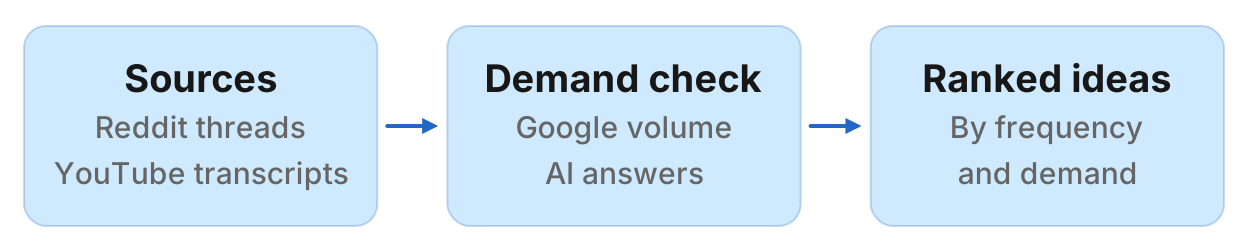
To find content ideas with AI, have your agent mine Reddit threads and YouTube transcripts for the questions your audience keeps asking, then check each question against Google search volume and what AI engines answer today. The output is a short, ranked list of topics with the threads and videos behind each one, so you write what people already want instead of guessing.
This guide is the workflow itself: what to give your agent, the five passes it runs, how to score ideas, what a finished list looks like, and the prompts to copy. If you are still choosing a server, the best Reddit MCP servers and best YouTube MCP servers compare the options.
What you need before you start
- A topic and an audience in one line. "Home espresso for beginners" works better than "coffee". The narrower the line, the fewer off-topic threads your agent reads.
- Reddit and YouTube tools. Any MCP server that can search posts, read comments and fetch transcripts. Built-in web search in ChatGPT or Claude can read a known page but cannot search a subreddit by date or pull a full transcript.
- Demand tools. Keyword volume for Google, and a way to run a question through ChatGPT, Gemini or Perplexity and read the answer. This is the step most idea lists skip.
- Your existing URLs. A sitemap or a list of what you have already published, so your agent can drop ideas you already cover.
Manifold covers all four in one hosted server: Reddit tools, YouTube tools, keyword data and AI answers. Every workspace gets 250 free credits a month, and Pro starts at $20/mo. Setup for Claude, ChatGPT and Cursor is in the client docs.
The five passes your agent runs
Pass 1: find where the conversation is
Your agent searches Reddit for subreddits on your topic and keeps the ones with recent activity, then searches YouTube for videos from the last year with real view counts. Ask for a shortlist before it reads anything: three to five subreddits and ten videos is enough for one round.
Pass 2: pull the questions, in the audience's words
Your agent reads the top threads from the last three to six months and the comment sections under each video, plus the transcripts. It keeps three kinds of signal:
- Direct questions, such as "why does my espresso taste sour".
- Complaints, which are questions in disguise ("my grinder clumps no matter what").
- Gaps in videos, where commenters ask something the creator skipped.
Keep the exact phrasing. "Sour shot" and "under-extracted" are the same problem, but your readers search the first one.
Pass 3: cluster
Twenty threads usually collapse into six to ten distinct problems. Your agent groups near-duplicates and counts how many threads, comments and videos raise each one.
Pass 4: check demand
For each cluster your agent looks up Google search volume for the main phrasing and two or three variants, and runs the question through one or two AI engines to read what they answer today. A question with search volume and a vague or outdated AI answer is the strongest signal you will get.
Pass 5: score and drop
Your agent scores each cluster, removes anything you already have a page for, and returns the top ideas with source links.
How to score ideas
A simple score keeps the list honest. Ask your agent to rate each cluster from 1 to 3 on four things:
| Signal | 1 | 2 | 3 |
|---|---|---|---|
| Mentions | One or two threads | Three to nine threads or videos | Ten or more |
| Google demand | No measurable volume | Some volume on a variant | Clear monthly volume on the main phrasing |
| AI answer quality | Complete and current | Generic or partly wrong | Missing, vague or outdated |
| Fit | Loosely related to what you sell | Adjacent | The problem your product solves |
Add the four scores and sort. Anything at 10 or more is worth a brief this week; anything at 6 or less can wait.
What a finished list looks like
Here is the shape of the output for "home espresso for beginners". The numbers are illustrative, to show the format; your agent fills in real counts and volumes from its tools.
| Idea | Mentions | Google demand | AI answer | Fit | Score | Sources |
|---|---|---|---|---|---|---|
| Why espresso tastes sour and how to fix it | 3 | 3 | 2 | 3 | 11 | 6 threads, 2 videos |
| Grind size chart for each budget grinder | 2 | 2 | 3 | 3 | 10 | 4 threads, 3 videos |
| Is a bottomless portafilter worth it | 2 | 2 | 2 | 2 | 8 | 3 threads |
| Descaling vs backflushing, and how often | 1 | 2 | 1 | 2 | 6 | 1 thread, 1 video |
Ask for each row to link the exact threads and timestamps it came from. Those links become your research section, and the phrasing people used becomes your headings.
Example prompts
Paste these into Claude or ChatGPT once your server is connected.
Run the full workflow:
Find the most discussed Reddit threads about home espresso from the last three months, pull the questions people keep asking, check which of them have Google search volume, see what ChatGPT answers for each today, and give me ten content ideas ranked by demand and how poorly ChatGPT currently answers them, with links.
Score with the table above:
Cluster these questions, then score each cluster 1 to 3 on mentions, Google demand, AI answer quality (3 means missing or weak) and fit with [our product]. Sort by total score and drop anything already covered on [our sitemap URL].
Mine YouTube comments for gaps:
Find the ten most viewed YouTube videos from the last year about small business CRM, read the transcripts and the top comments, and list the questions viewers ask that the video did not answer. Include the video link and the comment for each.
Turn a competitor's complaints into topics:
Search Reddit and YouTube comments for complaints about Mailchimp from the last six months, group them by missing feature, check which have Google search volume as a question, and give me the five topics with the strongest evidence.
Spot emerging problems:
Search Reddit for threads about AI agents from the last month, find the problems people mention most, check which have rising search volume on Google, and list the ones no top-ranking page answers well yet.
Common mistakes
- Counting upvotes instead of repeats. One viral thread is one data point. A question that shows up in ten small threads is stronger.
- Skipping the demand check. Plenty of Reddit questions have no search volume and no AI demand. They make good replies, not good articles.
- Paraphrasing too early. Keep the audience's words through scoring. Rewrite only when you write the brief.
- Reading too many sources at once. Five subreddits and ten videos per round keeps the list focused and the cost low. Run another round for a new angle.
From ideas to a published post
The workflow stops at a ranked list. To turn the top idea into a brief, score a draft and publish it, see the best MCP servers for content marketing. For more on Reddit search itself, including operators and subreddit finders, read how to search Reddit with AI.
Run this in your agent
Connect Manifold to Claude, ChatGPT or Cursor, then paste this prompt.
Find the most discussed Reddit threads about home espresso from the last three months, pull the questions people keep asking, check which of them have Google search volume, see what ChatGPT answers for each today, and give me ten content ideas ranked by demand and how poorly ChatGPT currently answers them, with links.