How to get cited by ChatGPT
ChatGPT cites the pages its web search finds, and for buyer questions most of them are best-of lists. We sorted 118 pages that ChatGPT, Gemini and AI Overviews cited to show what gets picked, then turned it into steps you can take or hand to your agent.

How do I get ChatGPT to cite us?
ChatGPT cites the pages its web search finds for a buyer's question, and for "best X for Y" questions most of those pages are best-of lists. So the work is in three places: get your brand onto the lists that rank for your category, publish your own clear list or comparison page, and make sure OpenAI's search crawler can read your site. We asked ChatGPT, Gemini and Google's AI Overviews six buyer questions and sorted all 118 pages they cited. Below is what they cited, why, and the steps that follow from it.
How ChatGPT picks the pages it cites
For a question that needs current facts, ChatGPT runs a web search, reads a set of results and cites some of them in the answer. Two details from our test matter most.
It rewrites your buyer's question into its own search. For "best crm for startups", ChatGPT searched for "best CRM software for startups 2026 HubSpot Pipedrive Zoho Attio Folk Salesforce pricing features". It added the year, the word pricing, and the brands it already had in mind. In every one of the six prompts the search named brands before ChatGPT had read a page. A brand the model does not already connect with the category is not in that search.
It reads more than it cites. ChatGPT read 11 to 17 search results per prompt and cited 3 to 7 of them. Most of its other citations were links to the product or pricing pages of the brands it named: "Explore HubSpot", "View Klaviyo pricing", "Visit 1Password Families".
So a citation needs two things: a page that ranks in the search ChatGPT runs, and a page that is easy to quote once it is read.
What AI answers cite for "best X for Y" questions
We ran six prompts, from CRM and project management software to running shoes, on ChatGPT, Gemini and Google's AI Overviews on 16 October 2026, and sorted every unique page cited.
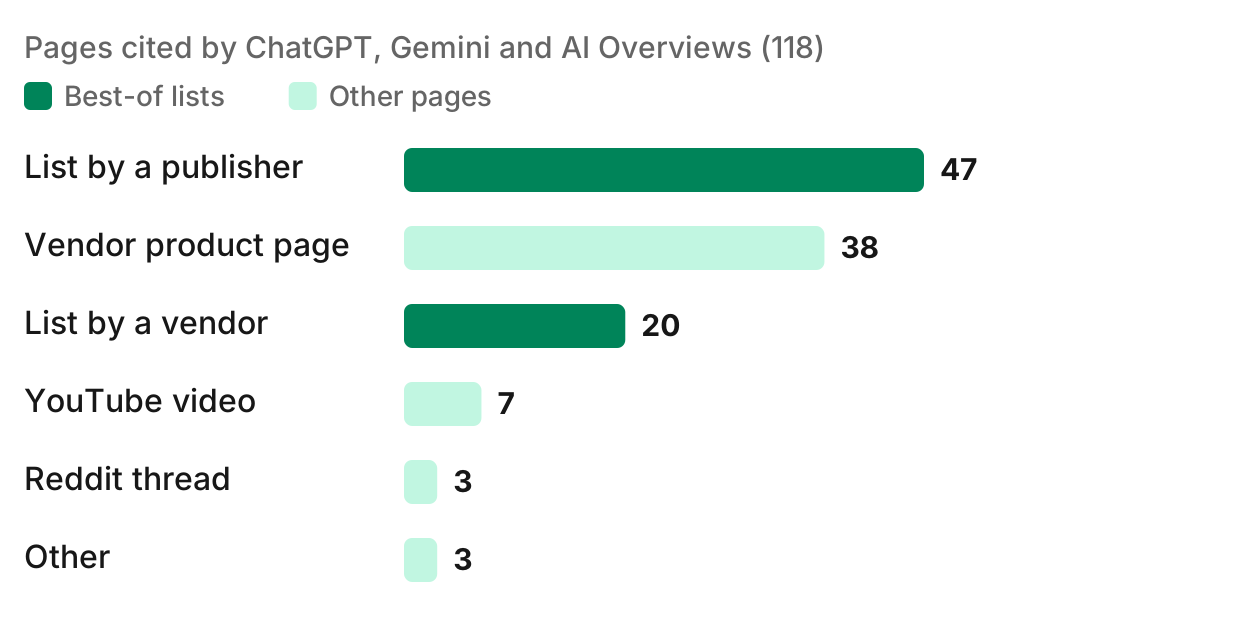
- Best-of lists and comparisons were 67 of the 118 pages. 47 were by publishers and review sites (NerdWallet, Runner's World, Zapier, TechRadar), and 20 were by companies that sell in the category.
- A vendor's own list gets cited. Attio's "Best CRMs for startups in 2026" was cited by all three engines. Omnisend's "Omnisend vs. Mailchimp vs. Klaviyo" and Shopify's email marketing roundup were cited by ChatGPT, and Drip, Klaviyo, Bench and Lettuce had their own lists cited by Gemini.
- ChatGPT links product and pricing pages. 34 of its 54 citations were the official pages of brands it recommended, often the pricing page.
- The engines differ. Gemini cited only lists. AI Overviews was the only engine to cite YouTube videos (7) and Reddit threads (3).
Six prompts is a small sample, and AI answers change from run to run. Run the same check on your own category before you plan around it.
How to get cited by ChatGPT
1. Let OAI-SearchBot read your site
OpenAI's crawler documentation says OAI-SearchBot is the crawler that surfaces sites in ChatGPT's search, and that sites which block it are not shown in ChatGPT's search answers. GPTBot is a separate crawler for model training, and each setting is independent: you can block GPTBot and still allow OAI-SearchBot. OpenAI says a robots.txt change takes about 24 hours to apply to search. For the exact rules, and how other sites set them, see what OAI-SearchBot is and how to allow it.
OpenAI says ChatGPT search sometimes partners with other search providers, so a page the main search engines have not indexed may be harder for it to find. Check your key pages in Google Search Console and Bing Webmaster Tools.
Check the firewall too. A CDN rule that blocks unknown bots can turn OAI-SearchBot away before it reads robots.txt. And keep your main content in the HTML the server sends, since a page that only fills in with JavaScript can look empty to a crawler.
2. Get onto the lists that rank for your category
Lists were the largest group of pages cited. Find the lists for your category: search the questions your buyers ask, and read which pages the AI answers cite today. Then ask each author to review your product, with something that makes the list better for its readers, such as a free account to test, current pricing or a fact the list has wrong. Pages cited by more than one engine, or for more than one prompt, are the first to work on.
3. Publish your own "best X for Y" or comparison page
Attio's own list was cited by every engine for "best crm for startups". A vendor list works when it reads as a fair guide: it names the competitors, says who each one suits, includes the cases where another tool is the better choice, and shows current prices. Write it for the exact question, with the year in the title if the list is current, because ChatGPT added the year to every search it ran.
4. Make your product and pricing pages easy to quote
When ChatGPT names you, it links your site, often the pricing page. Say on the page who the product is for, what it does and what it costs, in plain sentences in the HTML. A pricing page that only says "contact sales" gives the engine nothing to quote.
5. Become a brand the model connects with the category
ChatGPT put brand names in its search before it read any page. Those names come from what the model already knows: the brands that reviews, forums, news and lists mention with the category. Mentions across those sources, built over months, are what puts a brand in that first search. Reddit threads and YouTube videos about your category count toward this, and AI Overviews cites them directly.
6. Answer the question in the first lines of each section
An engine quotes a passage, not a page. Lead each section with a direct answer, then the detail. Use the buyer's words in the headings, and put comparisons in tables. Give facts a date and a source.
Have your agent find the pages to target
Finding which pages the engines cite for your category, and which of them leave you out, is a lot of manual prompting. An agent with an AI visibility MCP server can do it in one pass:
- Run your buyer questions on ChatGPT, Gemini, Claude, Perplexity and AI Overviews, with your brand and your competitors to detect.
- List every page cited where a competitor is named and you are not, with the number of engines and prompts that cite each.
- Sort the pages by type: lists to pitch, Reddit threads and videos to join, competitor pages to answer with your own.
- Check that OAI-SearchBot and the other answer crawlers can reach your site.
Run this in your agent
Connect Manifold to Claude, ChatGPT or Cursor, then paste this prompt.
Ask ChatGPT, Gemini, Claude, Perplexity and Google's AI Overviews the questions our buyers ask about [category]. List every page they cite where a competitor is named and we are not, ranked by how many engines and prompts cite it, and sort them into lists to pitch, threads and videos to join, and competitor pages to answer. Then check that OAI-SearchBot can reach our site.
Manifold's AI visibility MCP server runs the prompts live on each engine and returns the answers, the brands named and the pages cited, and its site readiness check costs no credits. To track whether ChatGPT names you over time, see how to track your brand's visibility in ChatGPT. To connect the same tools inside ChatGPT, see ChatGPT for SEO: workflows and setup.
How to tell if ChatGPT sends you traffic
OpenAI's publisher FAQ says ChatGPT adds utm_source=chatgpt.com to the links it sends. Filter your analytics on that source to see which pages ChatGPT sends readers to. Clicks show only part of it: an answer can name you without a click, so check the answers themselves each month as well.